
Every motorcyclist knows the feeling. You set off on a ride with nothing but open road ahead of you, the weather is perfect, the route is dialled in, and then somewhere around the 90 minute mark your body starts telling you a different story. That familiar ache sets in. The numbness creeps up. What should be an enjoyable day in the saddle becomes a countdown to the next fuel stop so you can stand up and give your backside a break.
It is one of those problems that riders just accept as part of the deal. But it does not have to be.
Where the problem starts
To understand why motorcycle seats become uncomfortable, you need to think about what is actually happening to your body when you sit down. Your full weight is being channelled through a surprisingly small contact area, and within that area the load is not evenly spread. The bulk of the pressure concentrates around two bony points at the base of your pelvis called the ischial tuberosities. If you have ever sat on a hard bench for too long, you will have felt them.
On a motorcycle seat the problem is amplified. You are sitting in a largely fixed position, often for hours at a time, with very little opportunity to shift your weight around the way you might on a sofa or office chair. The seat foam, no matter how well intentioned, compresses under those pressure points and before long you are essentially sitting on a hard surface. Blood flow to the compressed tissue reduces, heat builds up, and your body starts sending increasingly loud signals that something needs to change.
This is not just about comfort either. Reduced blood flow and sustained pressure on soft tissue is a well documented medical concern. In clinical settings, this exact mechanism is what leads to pressure injuries in patients who are wheelchair bound or bedridden. It is a problem that the medical world has spent decades researching and solving.

A solution borrowed from medicine
Air flotation technology was not originally designed for motorcyclists. It was developed in the medical sector as a way to prevent pressure injuries in people who spend extended periods seated or lying in one position. The principle is elegant in its simplicity. Rather than trying to add more padding, which eventually compresses and fails, air flotation uses a network of interconnected air cells that respond dynamically to the body above them.
When you sit on an air flotation surface, the air inside the cells moves freely between them. Areas of high pressure naturally push air towards areas of lower pressure, and the result is that your weight distributes more evenly across the entire contact surface. The concentrated hotspots that cause pain on a traditional seat are spread out, and the pressure at any single point drops significantly.
This is the technology that sits at the heart of every ComfortAir seat cushion. Rather than reinventing the wheel, ComfortAir took a principle that was already medically proven and engineered it into a format that works on a motorcycle seat. The interconnected air cells act as thousands of tiny pressure regulators, constantly adjusting to your body position and redistributing load in real time.
What the pressure maps actually show
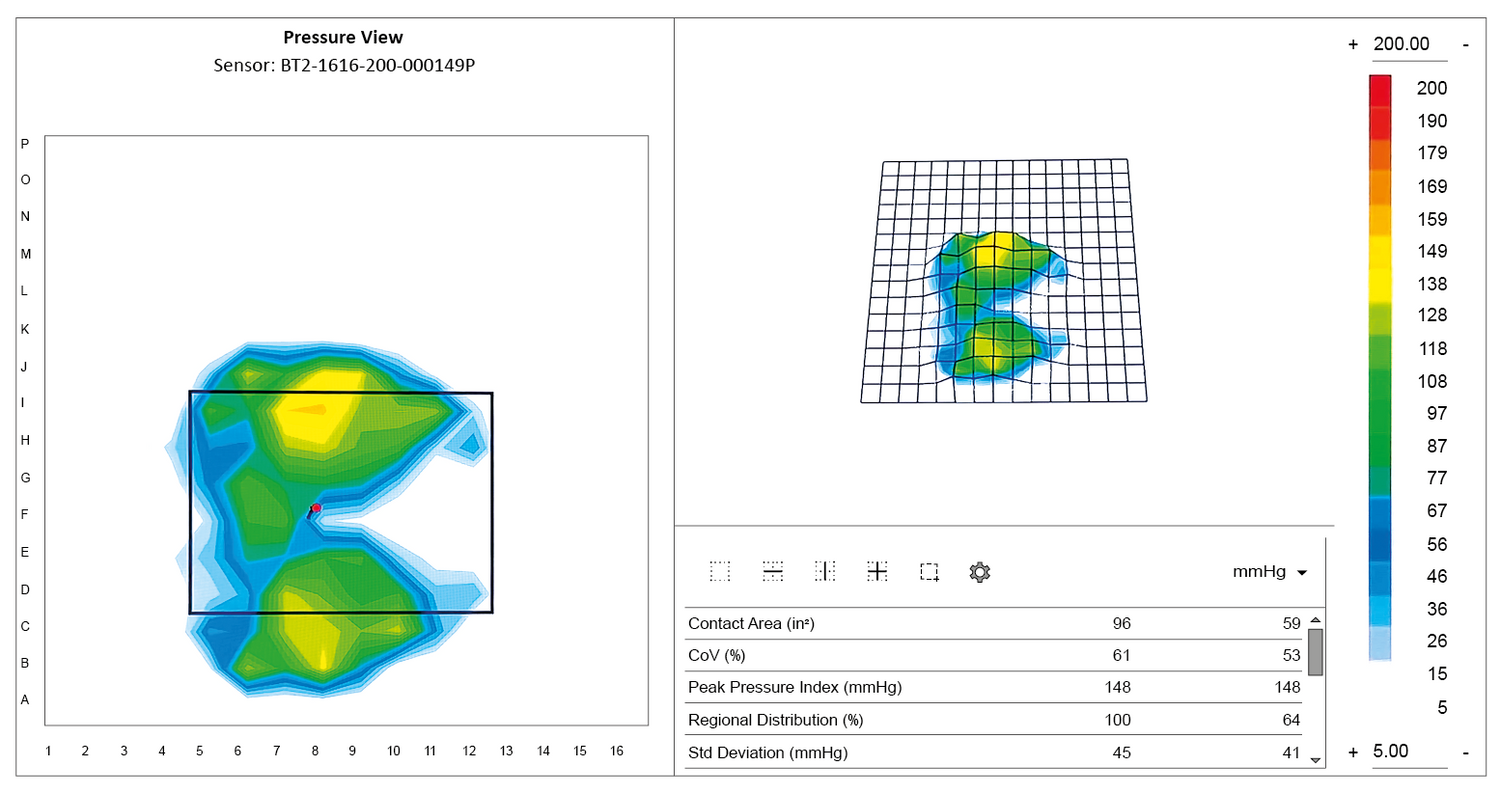
We use medical grade pressure mapping equipment to measure exactly what is happening at the interface between rider and seat. The system uses a sensor mat containing hundreds of individual pressure sensors, each recording the force applied at that specific point. The readings are measured in mmHg (millimetres of mercury), the same unit used in blood pressure readings, and displayed as a colour coded heat map. Blue and green represent low pressure. Yellow and orange are moderate. Red indicates concentrated high pressure zones where blood flow is most at risk of being restricted.
Both of the maps shown here were captured under identical conditions. The same rider, the same motorcycle seat, the same seated position, measured after 10 minutes of static sitting. The only variable is the presence of a ComfortAir cushion.
Without ComfortAir:
The results on a standard seat are stark. Two intense red and yellow zones sit exactly where the ischial tuberosities make contact with the seat, with a peak pressure index of 192 mmHg. That is a significant amount of force concentrated into a very small area. The 3D view makes this even clearer, with sharp peaks rising from the surface like a topographic map of a mountain range. The standard deviation across the contact area is 64 mmHg, which tells us the pressure is very unevenly distributed with extreme highs and lows across the seating surface.
With ComfortAir:
Now look at what happens when a ComfortAir cushion is introduced. The red hotspots disappear entirely. The dominant colours shift to greens and light blues, with only modest areas of yellow remaining. The peak pressure index drops from 192 mmHg to 148 mmHg, a reduction of 23%. Just as importantly, the standard deviation falls from 64 mmHg to 45 mmHg, a 30% improvement, meaning the pressure that remains is far more evenly spread across the entire contact surface. Those aggressive peaks in the 3D view flatten out into gentler, more uniform contours.

The pressure is still there, of course, because gravity has not changed, but it has been redistributed so that no single point is bearing a disproportionate share of the load. And that redistribution is exactly what makes the difference between a ride that ends at 90 minutes and one that goes well beyond 200 miles.

Why air beats foam and gel
There are plenty of seat comfort products on the market, from gel pads to memory foam inserts to sheepskin covers. Each has its merits, but they all share a fundamental limitation. Foam compresses over time and eventually bottoms out. Gel displaces under load but can only move so far before it too reaches its limits. Neither material actively redistributes pressure the way air does.
Air is different because it is infinitely adjustable and never loses its properties. The air inside a ComfortAir cushion behaves the same way on mile one as it does on mile one thousand. It does not compress permanently, it does not develop a memory of your shape that reduces its effectiveness, and it does not degrade with temperature changes the way gel can.
The other often overlooked benefit is vibration damping. Each air cell acts as a miniature shock absorber, softening the road buzz and vibration that travels through the motorcycle's frame and into the seat. Over a long ride, this constant low level vibration contributes significantly to fatigue, and reducing it makes a noticeable difference to how fresh you feel at the end of the day.
Getting the setup right
One thing that surprises most riders when they first use a ComfortAir cushion is how little air it actually needs. The instinct is to inflate it fully, but the technology works best when you can just barely feel the seat beneath you through the cushion. Starting with the bladder fully inflated, sit on the cushion in your normal riding position and slowly release air through the valve until you begin to feel the faintest contact with the seat below. That is the sweet spot. The cushion should feel like it has almost no air in it, but that small amount is all the cells need to do their job.

It is a counterintuitive setup process, but it is the key to getting the most out of the technology. Too much air and you are sitting on top of the cushion rather than in it. Too little and you bottom out. The narrow window in between is where the air flotation system works at its best, and once you find it, you will notice the difference within the first hour of riding.
Built to prove it
ComfortAir does not ask you to take any of this on faith. Every claim is backed by measurable, repeatable pressure mapping data captured using the same clinical grade equipment found in hospitals and rehabilitation centres around the world. A 23% reduction in peak pressure. A 30% improvement in pressure distribution. Zero red zones on the map. The technology is manufactured to UKCA and CE standards, and the results speak for themselves in the data.
If you have ever cut a ride short because of discomfort, or arrived at your destination feeling like you have aged ten years, this is the fix. Not a thicker seat, not a softer foam, but a fundamentally different approach to how pressure is managed between you and your motorcycle.
